
Academic CV template
Use this expanded structure for an early-career research or teaching application where outputs, methods and academic contribution matter.
Read the example as text
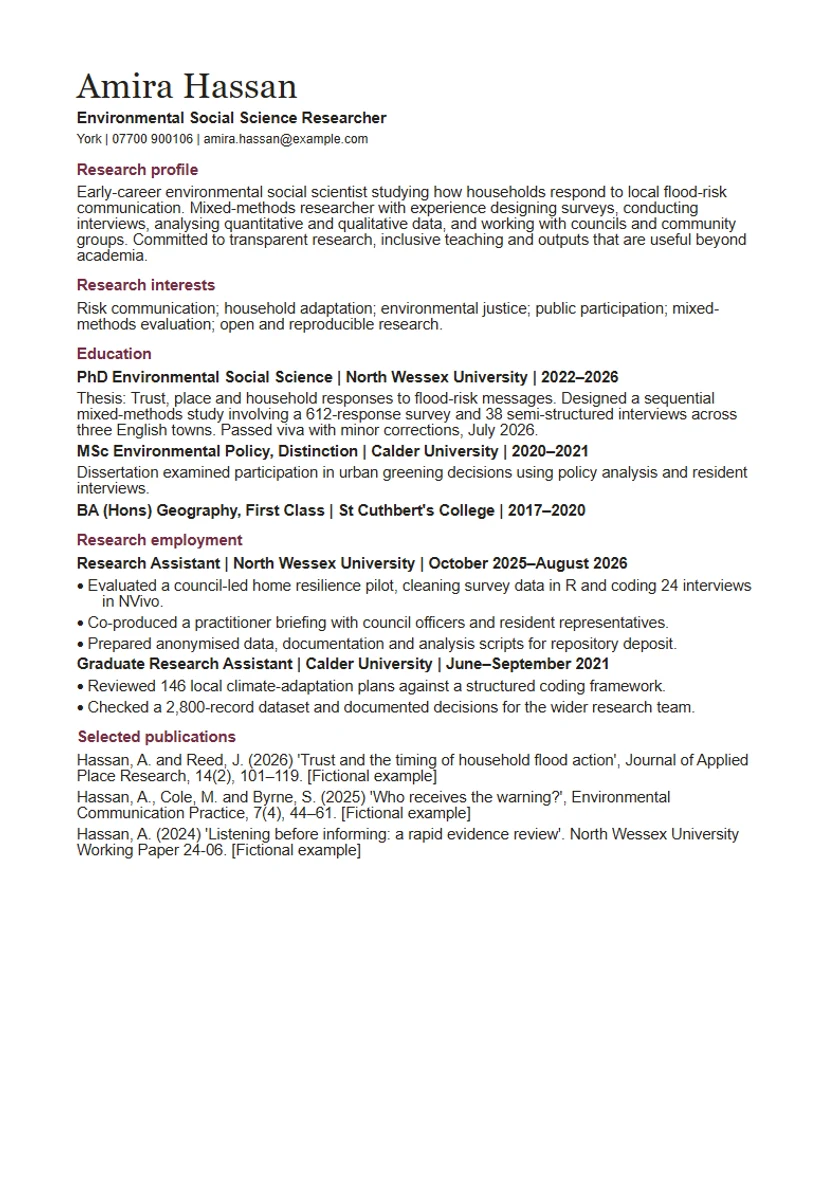
Research profile
Early-career environmental social scientist studying how households respond to local flood-risk communication. Mixed-methods researcher with experience designing surveys, conducting interviews, analysing quantitative and qualitative data, and working with councils and community groups. Committed to transparent research, inclusive teaching and outputs that are useful beyond academia.
Research interests
Risk communication; household adaptation; environmental justice; public participation; mixed-methods evaluation; open and reproducible research.
Education
PhD Environmental Social Science | North Wessex University | 2022–2026
Thesis: Trust, place and household responses to flood-risk messages. Designed a sequential mixed-methods study involving a 612-response survey and 38 semi-structured interviews across three English towns. Passed viva with minor corrections, July 2026.
MSc Environmental Policy, Distinction | Calder University | 2020–2021
Dissertation examined participation in urban greening decisions using policy analysis and resident interviews.
BA (Hons) Geography, First Class | St Cuthbert's College | 2017–2020
Research employment
Research Assistant | North Wessex University | October 2025–August 2026
Evaluated a council-led home resilience pilot, cleaning survey data in R and coding 24 interviews in NVivo.
Co-produced a practitioner briefing with council officers and resident representatives.
Prepared anonymised data, documentation and analysis scripts for repository deposit.
Graduate Research Assistant | Calder University | June–September 2021
Reviewed 146 local climate-adaptation plans against a structured coding framework.
Checked a 2,800-record dataset and documented decisions for the wider research team.
Selected publications
Hassan, A. and Reed, J. (2026) 'Trust and the timing of household flood action', Journal of Applied Place Research, 14(2), 101–119. [Fictional example]
Hassan, A., Cole, M. and Byrne, S. (2025) 'Who receives the warning?', Environmental Communication Practice, 7(4), 44–61. [Fictional example]
Hassan, A. (2024) 'Listening before informing: a rapid evidence review'. North Wessex University Working Paper 24-06. [Fictional example]
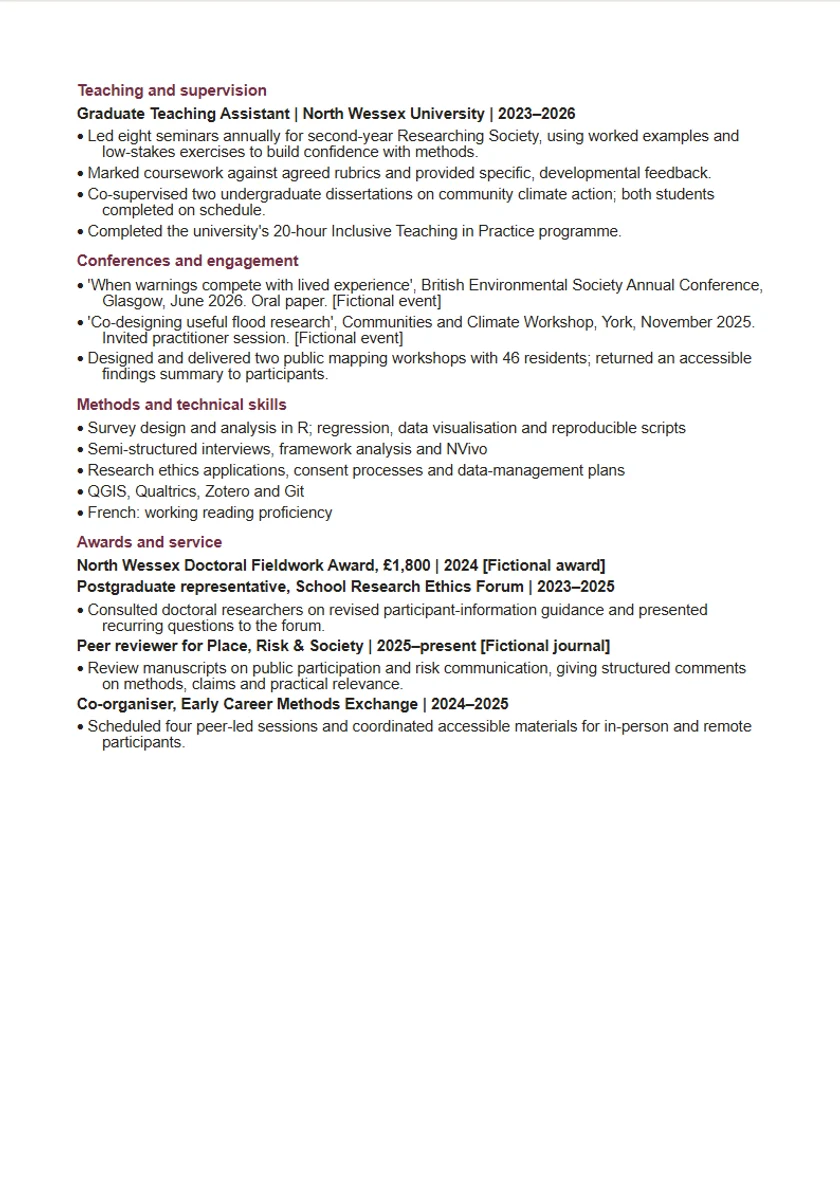
Teaching and supervision
Graduate Teaching Assistant | North Wessex University | 2023–2026
Led eight seminars annually for second-year Researching Society, using worked examples and low-stakes exercises to build confidence with methods.
Marked coursework against agreed rubrics and provided specific, developmental feedback.
Co-supervised two undergraduate dissertations on community climate action; both students completed on schedule.
Completed the university's 20-hour Inclusive Teaching in Practice programme.
Conferences and engagement
'When warnings compete with lived experience', British Environmental Society Annual Conference, Glasgow, June 2026. Oral paper. [Fictional event]
'Co-designing useful flood research', Communities and Climate Workshop, York, November 2025. Invited practitioner session. [Fictional event]
Designed and delivered two public mapping workshops with 46 residents; returned an accessible findings summary to participants.
Methods and technical skills
Survey design and analysis in R; regression, data visualisation and reproducible scripts
Semi-structured interviews, framework analysis and NVivo
Research ethics applications, consent processes and data-management plans
QGIS, Qualtrics, Zotero and Git
French: working reading proficiency
Awards and service
North Wessex Doctoral Fieldwork Award, £1,800 | 2024 [Fictional award]
Postgraduate representative, School Research Ethics Forum | 2023–2025
Consulted doctoral researchers on revised participant-information guidance and presented recurring questions to the forum.
Peer reviewer for Place, Risk & Society | 2025–present [Fictional journal]
Review manuscripts on public participation and risk communication, giving structured comments on methods, claims and practical relevance.
Co-organiser, Early Career Methods Exchange | 2024–2025
Scheduled four peer-led sessions and coordinated accessible materials for in-person and remote participants.
Fictional example for a environmental social science researcher. Replace every detail with your own. The PDF shows the download layout.
How to use this template
Follow the academic criteria
Reorder sections around the post: research outputs for a research contract, or teaching design and feedback for a teaching-focused post.
State your contribution
For collaborative work, distinguish what you designed, analysed, wrote or coordinated without overstating ownership.
Use a consistent citation style
Give complete, verifiable publication details and clearly label accepted, in-press or submitted work.
Curate rather than catalogue
Select outputs and presentations that demonstrate fit; use a full publications list only when requested or link to a maintained profile.
Protect confidential information
Describe participants, partners and datasets at the level allowed by consent, ethics and contractual terms.