Narrative CV template

A narrative CV tells a panel what you have contributed, in prose under four headings, instead of listing every post and paper.

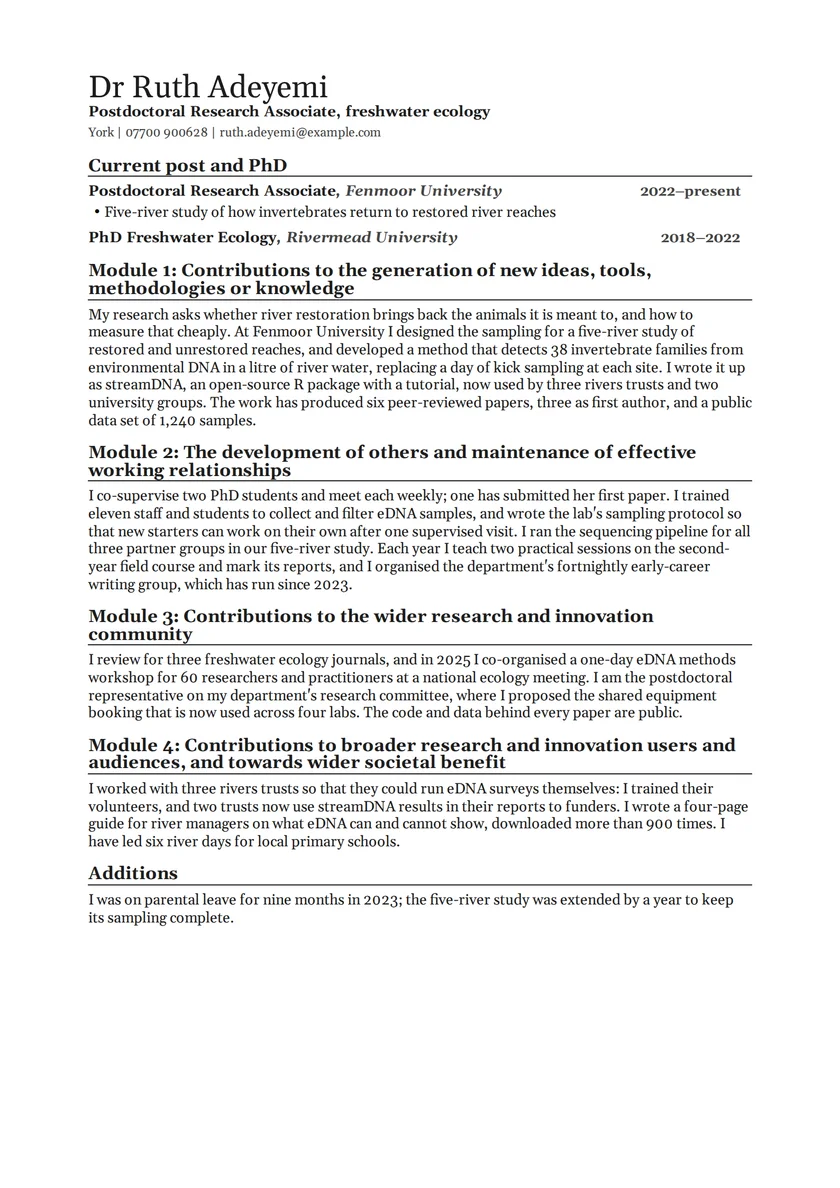
This template follows UKRI’s Résumé for Research and Innovation (R4RI): the four modules and Additions, written for a made-up postdoctoral researcher. The first section, your post and PhD, is for funders and employers that ask for it; delete it when the call asks only for the modules.

Academic design1 page
Read the example as text
Dr Ruth Adeyemi
Postdoctoral Research Associate, freshwater ecology
York · 07700 900628 · [email protected]

Current post and PhD

Postdoctoral Research Associate, Fenmoor University 2022–present

Five-river study of how invertebrates return to restored river reaches

PhD Freshwater Ecology, Rivermead University 2018–2022

Module 1: Contributions to the generation of new ideas, tools, methodologies or knowledge

My research asks whether river restoration brings back the animals it is meant to, and how to measure that cheaply. At Fenmoor University I designed the sampling for a five-river study of restored and unrestored reaches, and developed a method that detects 38 invertebrate families from environmental DNA in a litre of river water, replacing a day of kick sampling at each site. I wrote it up as streamDNA, an open-source R package with a tutorial, now used by three rivers trusts and two university groups. The work has produced six peer-reviewed papers, three as first author, and a public data set of 1,240 samples.

Module 2: The development of others and maintenance of effective working relationships

I co-supervise two PhD students and meet each weekly; one has submitted her first paper. I trained eleven staff and students to collect and filter eDNA samples, and wrote the lab's sampling protocol so that new starters can work on their own after one supervised visit. I ran the sequencing pipeline for all three partner groups in our five-river study. Each year I teach two practical sessions on the second-year field course and mark its reports, and I organised the department's fortnightly early-career writing group, which has run since 2023.

Module 3: Contributions to the wider research and innovation community

I review for three freshwater ecology journals, and in 2025 I co-organised a one-day eDNA methods workshop for 60 researchers and practitioners at a national ecology meeting. I am the postdoctoral representative on my department's research committee, where I proposed the shared equipment booking that is now used across four labs. The code and data behind every paper are public.

Module 4: Contributions to broader research and innovation users and audiences, and towards wider societal benefit

I worked with three rivers trusts so that they could run eDNA surveys themselves: I trained their volunteers, and two trusts now use streamDNA results in their reports to funders. I wrote a four-page guide for river managers on what eDNA can and cannot show, downloaded more than 900 times. I have led six river days for local primary schools.

Additions

I was on parental leave for nine months in 2023; the five-river study was extended by a year to keep its sampling complete.

Fictional example for a postdoctoral research associate, freshwater ecology. Every person and employer in it is invented; replace every detail with your own. Select the page to zoom in.

Before you use it

One page of prose in the Academic design: about 320 words in the four modules and 23 in Additions. Check the word limit in the funding call before you paste it in, because each call sets its own.

See the Academic design on its own page or compare one CV in all eight designs.

Inside this example
  • Current post and PhD: 22 words here
  • Module 1: Contributions to the generation of new ideas, tools, methodologies or knowledge: 105 words here
  • Module 2: The development of others and maintenance of effective working relationships: 90 words here
  • Module 3: Contributions to the wider research and innovation community: 60 words here
  • Module 4: Contributions to broader research and innovation users and audiences, and towards wider societal benefit: 60 words here
  • Additions: 23 words here

How to use this template

01

Use each module heading once

UKRI asks for the four module headings, each used once, and a narrative rather than a CV format. Write sentences that say what you did and what came of it.

02

Choose contributions that fit this project

Only the past work that best shows you can deliver the proposed project belongs here. A narrative CV is not a full record, so leave out what does not support this application.

03

Give numbers a panel can check

Samples, users, students supervised, downloads: a figure turns a claim into evidence. Name outputs so a reviewer can find them.

04

Keep Additions for context

A career break, a secondment or part-time working goes in Additions, with what it changed for your work. Skills and outputs added there are not assessed.

05

Write for the team when the call asks

For a team application UKRI wants one R4RI for the whole team. Say who brings which skill, and keep each person’s contribution to the work it supports.

If the employer asks for a particular file type, a page limit or an application form, do what they ask, even where this page suggests otherwise. CV format and file types explains the choices.