Disability disclosure cover letter example
Whether you mention a disability in a cover letter, and how much you say, is your choice. If you do, keep it short and practical: what it is in a few words, how you work with it, and any adjustment you would like at interview. This example is a data analyst who is dyslexic and asks for extra time on a timed test.
Read the letter as text
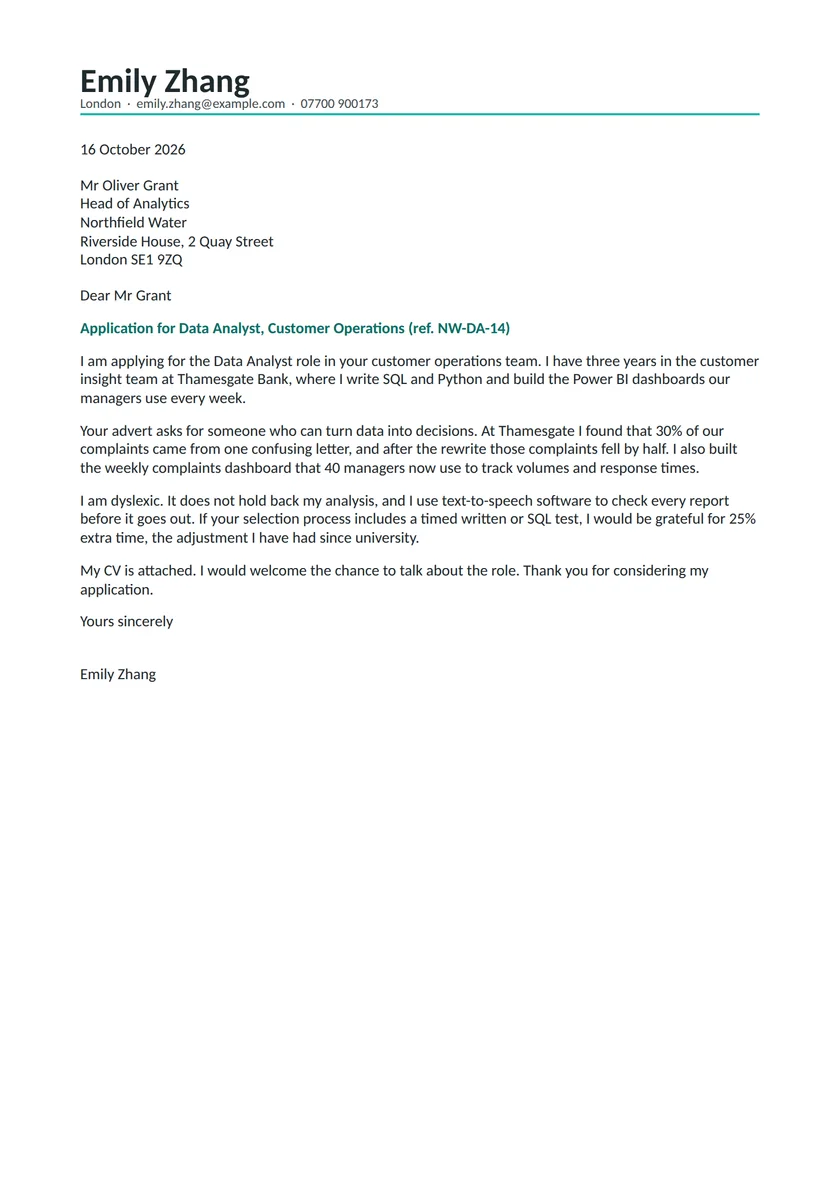
Emily Zhang
London · [email protected] · 07700 900173
16 October 2026
Mr Oliver Grant
Head of Analytics
Northfield Water
Riverside House, 2 Quay Street
London SE1 9ZQ
Dear Mr Grant
Application for Data Analyst, Customer Operations (ref. NW-DA-14)
I am applying for the Data Analyst role in your customer operations team. I have three years in the customer insight team at Thamesgate Bank, where I write SQL and Python and build the Power BI dashboards our managers use every week.
Your advert asks for someone who can turn data into decisions. At Thamesgate I found that 30% of our complaints came from one confusing letter, and after the rewrite those complaints fell by half. I also built the weekly complaints dashboard that 40 managers now use to track volumes and response times.
I am dyslexic. It does not hold back my analysis, and I use text-to-speech software to check every report before it goes out. If your selection process includes a timed written or SQL test, I would be grateful for 25% extra time, the adjustment I have had since university.
My CV is attached. I would welcome the chance to talk about the role. Thank you for considering my application.
Yours sincerely
Emily Zhang
Fictional letter from Emily Zhang, the applicant in the data analyst CV example. Every person and employer in it is invented.
Why each paragraph is there
I am applying for the Data Analyst role in your customer operations team. I have three years in the customer insight team at Thamesgate Bank, where I write SQL and Python and build the Power BI dashboards our managers use every week.
The role and your experience, as in any letter.
Your advert asks for someone who can turn data into decisions. At Thamesgate I found that 30% of our complaints came from one confusing letter, and after the rewrite those complaints fell by half. I also built the weekly complaints dashboard that 40 managers now use to track volumes and response times.
Your best evidence comes before the disclosure.
I am dyslexic. It does not hold back my analysis, and I use text-to-speech software to check every report before it goes out. If your selection process includes a timed written or SQL test, I would be grateful for 25% extra time, the adjustment I have had since university.
The disclosure: what it is, how you work with it and the one adjustment you ask for.
My CV is attached. I would welcome the chance to talk about the role. Thank you for considering my application.
A short close, the same as any letter.
Other ways to say it
Sentences for other conditions and adjustments. Use only what is true for you and what you want to share; you can also leave it until you are invited to interview.
Hearing. I am hard of hearing and lip-read. For the interview, a quiet room, or captions on a video call, would help me take part fully.
Mental health. I have an anxiety condition that I manage well. It would help me to know the format of the interview and who will be on the panel beforehand.
Mobility. I use a wheelchair. Could you let me know whether the interview room has step-free access, so that I can plan my journey?
Autism. I am autistic. Clear, direct questions suit me best, and it would help to know the format and length of the interview beforehand.
A long-term condition. I have type 1 diabetes, which is well controlled. On a long assessment day I may need a short break to check my blood sugar.
Keeping it general. I have a disability and may need a small adjustment at interview. I would be glad to discuss it with whoever arranges the interviews.
Under the Equality Act 2010 it is against the law for employers to discriminate against you because of a disability, and that covers application forms, interview arrangements and aptitude or proficiency tests. An employer has to make ‘reasonable adjustments’ to avoid you being put at a disadvantage compared to non-disabled people in the workplace (GOV.UK: Disability rights, employment, checked 17 October 2026).
Access to Work can help you get or stay in work if you have a physical or mental health condition or disability. It can help pay for communication support at a job interview, such as a BSL interpreter or lipspeaker if you are deaf or hard of hearing (GOV.UK: Access to Work, checked 17 October 2026). There is a different system in Northern Ireland.
This page shows how to word a letter, not legal advice. For advice on your own situation, ask Acas or Citizens Advice.