
Check the instructions and research the employer
Read the advert, person specification and application instructions before drafting. Note the exact role title, reference number, requested format and closing date. If the employer asks for answers in an application form rather than a separate letter, follow that process. If the advert says not to send a cover letter, leave it out. If a letter is optional, use it to add a specific reason for applying or useful evidence rather than repeating the CV.
Research enough to explain a real connection. Use the employer's own website and the vacancy to identify the work, priorities or service that interest you. Avoid generic praise that could be sent to any organisation. Try to find the person handling the application in the advert or on the employer's website; if no name is available, use a professional general greeting.
- Confirm the role title, employer name and reference number.
- Choose one or two requirements you can prove with truthful examples.
- Record one specific reason for applying to this employer.
- Check whether the letter should be an attachment, an email or part of a form.
Use a three-to-five-paragraph structure
The National Careers Service describes a cover letter as a short letter, usually three to five paragraphs. Open by naming the role and purpose of the letter. Use the middle paragraphs to connect selected requirements to evidence and to explain why the employer's work interests you. Close by pointing to the CV, thanking the reader and giving a clear way to contact you.
A named greeting usually closes with ‘Yours sincerely’; a general ‘Dear Sir or Madam’ greeting closes with ‘Yours faithfully’. For an email, a concise subject line should name the role and, when supplied, its reference number. Keep the same professional tone whether the letter is pasted into an email or sent as a document.
- Paragraph 1: name the vacancy and your reason for writing.
- Paragraph 2: prove one important requirement with a focused example.
- Paragraph 3: connect another requirement and your motivation to the employer's actual work.
- Final paragraph: confirm interest, refer to the CV and close politely.
Add context to evidence from your CV
Choose evidence that answers the vacancy rather than the most impressive sounding fact. State the situation briefly, make your action clear and give the result you can support. The CV can hold the compact bullet; the letter can explain why that example matters for this role.
For a career change, keep your real job title and translate the overlap in the work. The Hannah Price career-change CV foregrounds schedules, action tracking, budgets and stakeholder updates from hospitality because those are relevant to project support. It does not claim project experience that the candidate does not have.
If a gap needs context, keep the explanation proportionate and use the guide to explaining a gap in your CV to decide whether it belongs in the CV, cover letter, application form or interview. You control how much health or personal information you share.
I have excellent project skills and would be perfect for this role.
AfterDuring a six-week venue refurbishment, I built the action tracker used to coordinate contractors, stock moves, staff training and mandatory reopening checks.
Read the complete fictional example
This original example matches the fictional facts in Hannah Price's career-change CV. The employer, addressee, vacancy and addresses are also fictional. Use the annotations to see each paragraph's job, then replace every example detail with evidence from your own application.
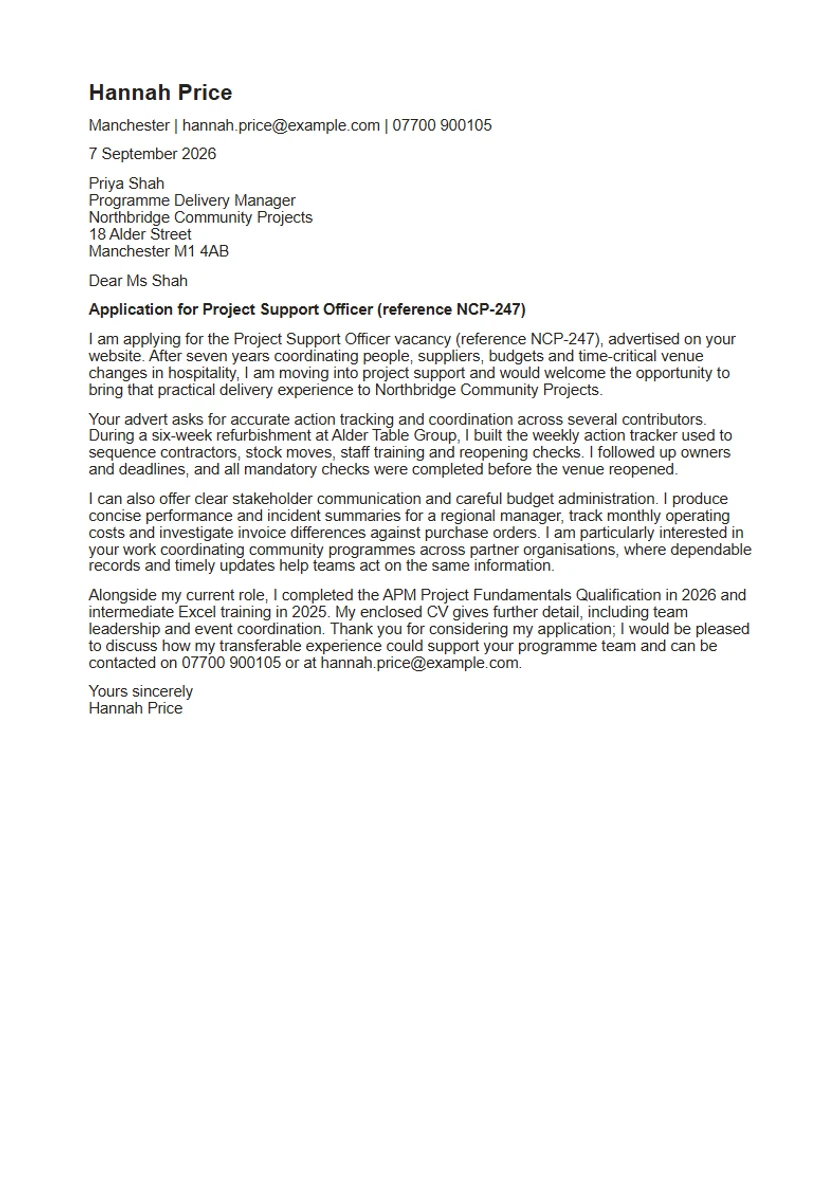
Original fictional example: Hannah Price is applying for a project support role. Compare the evidence with her career-change CV. Every applicant, organisation and application detail in this example is fictional.
Read the full letter and paragraph notes
Hannah Price
Manchester | hannah.price@example.com | 07700 900105
7 September 2026
Priya Shah
Programme Delivery Manager
Northbridge Community Projects
18 Alder Street, Manchester M1 4AB
Dear Ms Shah
Application for Project Support Officer (reference NCP-247)
I am applying for the Project Support Officer vacancy (reference NCP-247), advertised on your website. After seven years coordinating people, suppliers, budgets and time-critical venue changes in hospitality, I am moving into project support and would welcome the opportunity to bring that practical delivery experience to Northbridge Community Projects.
Your advert asks for accurate action tracking and coordination across several contributors. During a six-week refurbishment at Alder Table Group, I built the weekly action tracker used to sequence contractors, stock moves, staff training and reopening checks. I followed up owners and deadlines, and all mandatory checks were completed before the venue reopened.
I can also offer clear stakeholder communication and careful budget administration. I produce concise performance and incident summaries for a regional manager, track monthly operating costs and investigate invoice differences against purchase orders. I am particularly interested in your work coordinating community programmes across partner organisations, where dependable records and timely updates help teams act on the same information.
Alongside my current role, I completed the APM Project Fundamentals Qualification in 2026 and intermediate Excel training in 2025. My enclosed CV gives further detail, including team leadership and event coordination. Thank you for considering my application; I would be pleased to discuss how my transferable experience could support your programme team and can be contacted on 07700 900105 or at hannah.price@example.com.
Yours sincerely
Hannah Price
Why each paragraph is there
- Name the exact role, where you found it and the relevant direction of your application.
- Connect one important requirement to a specific, supportable example from the CV.
- Translate further evidence into the new setting without claiming experience you do not have.
- Reinforce readiness, point to the CV and close with accurate contact information.
Cross-check the complete application
Compare the final letter with the advert and CV. Names, dates, qualifications, results and notice period must agree. Remove claims that are not supported in the CV or that you could not explain at interview. Check that the employer name and role were not carried over from a previous application.
Use the employer's requested format. If you send a document, keep its typography consistent with the CV and follow the CV export checklist: reopen the exact attachment and inspect every page. The private CV editor can help you prepare the matching CV, but its checks are prompts rather than a hiring or parsing guarantee.
- Check the name you have addressed it to, the employer, the role and the reference number.
- Check every example is truthful and specific.
- Check contact details match the CV.
- Proofread the exact email or attachment you will send.
- Keep a copy so you can review it before an interview.