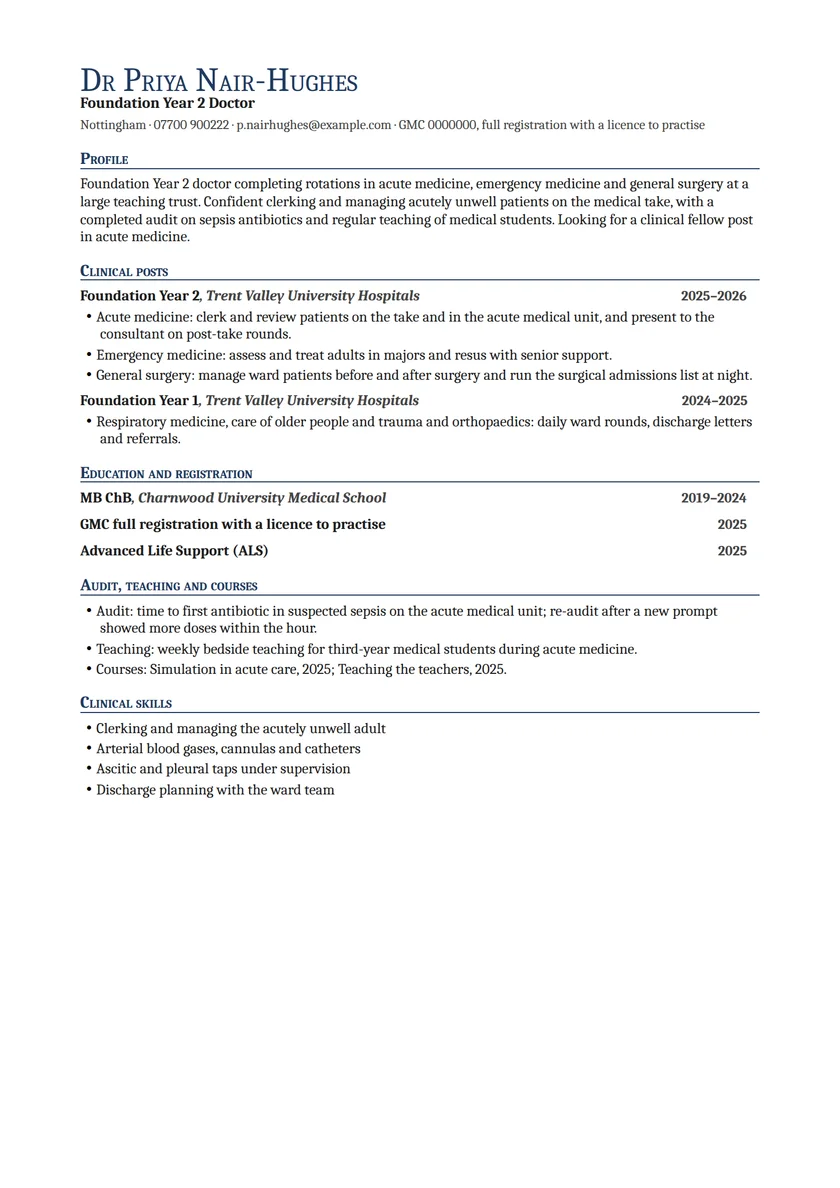
Doctor CV example

A doctor's CV starts with your GMC number and licence, then your posts in order with the specialty and hospital, then audit, teaching and courses. Keep each rotation to what you were responsible for.

This example is a second-year foundation doctor applying for a clinical fellow post in acute medicine.

Professional design1 page
Read the example as text
Dr Priya Nair-Hughes
Foundation Year 2 Doctor
Nottingham · 07700 900222 · p.nairhughes@example.com · GMC 0000000, full registration with a licence to practise

Profile

Foundation Year 2 doctor completing rotations in acute medicine, emergency medicine and general surgery at a large teaching trust. Confident clerking and managing acutely unwell patients on the medical take, with a completed audit on sepsis antibiotics and regular teaching of medical students. Looking for a clinical fellow post in acute medicine.

Clinical posts

Foundation Year 2, Trent Valley University Hospitals 2025–2026

Acute medicine: clerk and review patients on the take and in the acute medical unit, and present to the consultant on post-take rounds.

Emergency medicine: assess and treat adults in majors and resus with senior support.

General surgery: manage ward patients before and after surgery and run the surgical admissions list at night.

Foundation Year 1, Trent Valley University Hospitals 2024–2025

Respiratory medicine, care of older people and trauma and orthopaedics: daily ward rounds, discharge letters and referrals.

Education and registration

MB ChB, Charnwood University Medical School 2019–2024

GMC full registration with a licence to practise 2025

Advanced Life Support (ALS) 2025

Audit, teaching and courses

Audit: time to first antibiotic in suspected sepsis on the acute medical unit; re-audit after a new prompt showed more doses within the hour.

Teaching: weekly bedside teaching for third-year medical students during acute medicine.

Courses: Simulation in acute care, 2025; Teaching the teachers, 2025.

Clinical skills

Clerking and managing the acutely unwell adult

Arterial blood gases, cannulas and catheters

Ascitic and pleural taps under supervision

Discharge planning with the ward team

Fictional example for a doctor. Every person and employer in it is invented. Replace every detail with your own.

What hospital trusts look for, and where this CV shows it

The job asks you toWhere this CV shows it
Speak to patients and examine them on wards or in outpatient clinicsClerking on the medical take and daily ward rounds
Request patient tests, scans and X-rays, and analyse resultsAssessing adults in majors and resus, and blood gas sampling
Respond to emergency cases where neededEmergency medicine rotation and Advanced Life Support
Write medical reports and share these with your patient's GPDischarge letters and referrals
Supervise and train junior medical staffWeekly bedside teaching for medical students

The left column follows the National Careers Service job profile for a hospital doctor.

Facts checked against National Careers Service: Hospital doctor on and General Medical Council: The licence to practise on .

Inside this example
  • Profile: 52 words here
  • Clinical posts: 94 words here
  • Education and registration: 25 words here
  • Audit, teaching and courses: 48 words here
  • Clinical skills: 29 words here

How to write yours

01

GMC number at the top

Your registration and licence are the first thing checked; put them in the contact line.

02

One line per rotation

Give the specialty and what you were responsible for. A list of every procedure belongs in your portfolio.

03

Close the audit loop

Say what you changed and what the re-audit showed; a completed cycle is what interviewers ask about.

04

Follow the application route

If a post asks for an application form or portfolio, fill that in; keep this CV for posts that ask for one.

Rules and checks for a doctor's CV

  • GMC registration and licence. Doctors who practise medicine in the UK need a licence to practise along with the right type of registration, and employers must check it (General Medical Council). Give your GMC number.
  • Training. After a medical degree recognised by the GMC, doctors do 2 years of foundation training, then specialist training of 5 to 8 years depending on the specialty (National Careers Service). Say where you are in it.
  • Background checks. You'll need to pass enhanced background checks (National Careers Service).

Professional and two pages are normal for doctors; this one stays on one page because it is early in a career.