Paramedic CV example

A paramedic's CV is read for registration, driving and clinical judgement.

Put your HCPC registration and licence in the contact lines, give your caseload and crew role, name the conditions you manage and the decisions you make about who goes to hospital, and keep patients out of it. This example is a paramedic three years after qualifying.

Classic design1 page
Read the example as text
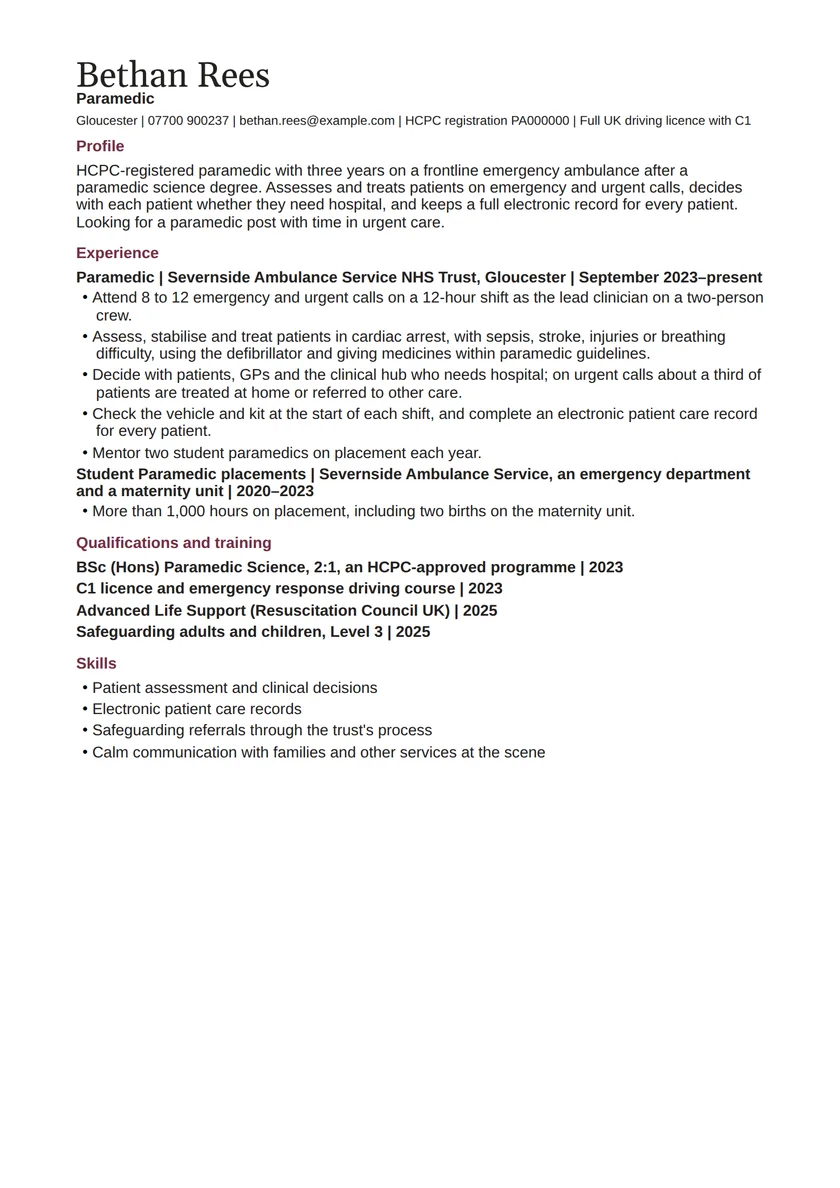
Bethan Rees
Paramedic
Gloucester · 07700 900237 · [email protected] · HCPC registration PA000000 · Full UK driving licence with C1

Profile

HCPC-registered paramedic with three years on a frontline emergency ambulance after a paramedic science degree. Assesses and treats patients on emergency and urgent calls, decides with each patient whether they need hospital, and keeps a full electronic record for every patient. Looking for a paramedic post with time in urgent care.

Experience

Paramedic | Severnside Ambulance Service NHS Trust, Gloucester | September 2023–present

Attend 8 to 12 emergency and urgent calls on a 12-hour shift as the lead clinician on a two-person crew.

Assess, stabilise and treat patients in cardiac arrest, with sepsis, stroke, injuries or breathing difficulty, using the defibrillator and giving medicines within paramedic guidelines.

Decide with patients, GPs and the clinical hub who needs hospital; on urgent calls about a third of patients are treated at home or referred to other care.

Check the vehicle and kit at the start of each shift, and complete an electronic patient care record for every patient.

Mentor two student paramedics on placement each year.

Student Paramedic placements | Severnside Ambulance Service, an emergency department and a maternity unit | 2020–2023

More than 1,000 hours on placement, including two births on the maternity unit.

Qualifications and training

BSc (Hons) Paramedic Science, 2:1, an HCPC-approved programme | 2023

C1 licence and emergency response driving course | 2023

Advanced Life Support (Resuscitation Council UK) | 2025

Safeguarding adults and children, Level 3 | 2025

Skills

Patient assessment and clinical decisions

Electronic patient care records

Safeguarding referrals through the trust's process

Calm communication with families and other services at the scene

Fictional example for a paramedic. Every person and employer in it is invented. Replace every detail with your own.

What ambulance services look for, and where this CV shows it

The job asks you toWhere this CV shows it
Respond to emergency calls8 to 12 emergency and urgent calls a shift as lead clinician
Work calmly and quickly to stabilise patientsCardiac arrest, sepsis, stroke, injuries and breathing difficulty
Use a defibrillator to revive patientsThe defibrillator in cardiac arrests, with Advanced Life Support in 2025
Give patients medicines and injectionsMedicines given within paramedic guidelines
Help to deliver babiesTwo births on a maternity placement
Attend non-emergency calls and decide whether patients need to go to hospitalAbout a third of urgent-call patients treated at home or referred to other care
Check equipment regularly and keep accurate recordsVehicle and kit checks each shift; a record for every patient

The left column follows the National Careers Service job profile for a paramedic.

Average pay: £32,000 a year for a starter and £48,000 for an experienced paramedic, working 37 to 42 hours a week (National Careers Service, checked 14 October 2026).

Facts checked against National Careers Service: Paramedic on .

Skills to list for this job

The skills the National Careers Service lists for a paramedic, in CV wording. Put down only the ones you can show, each with where you used it.

  • Healthcare and medicine
  • Sensitivity and understanding
  • Customer service
  • Patient and calm in stressful situations
  • Clear spoken communication
  • Public safety and security
  • Flexible and open to change
  • Working well with others
  • Competent with computers and everyday software
Choose them in the editor

From the National Careers Service profile, checked 17 October 2026.

A profile if you are starting out

This CV's profile is written for someone with experience. Here is the same job at the other level: copy it, or open it in the editor with this CV and write over it.

Final-year paramedic science student, expecting HCPC registration in the summer, with more than 1,000 placement hours on emergency ambulances, in an emergency department and on a maternity unit. Holds a full licence with C1. Looking for a newly qualified paramedic post.
Use in the editor
Inside this example
  • Profile: 51 words here
  • Experience: 137 words here
  • Qualifications and training: 31 words here
  • Skills: 25 words here

How to write yours

01

Give your caseload and role

Calls a shift, shift length and whether you lead the crew tell a manager your pace and responsibility in one line.

02

Name the conditions you manage

Cardiac arrest, sepsis, stroke, trauma: a short list shows your clinical range better than “wide experience”.

03

Show your decisions

Who stayed at home, who you referred and who went to hospital is the judgement services want more of. Give a share only if you can stand behind it.

04

Keep patients out of it

No names, ages with places, or details that could identify a patient, even when a case shows your skill.

Rules and checks for a paramedic's CV

Do I need to be registered with the HCPC?

You need to register with the Health and Care Professions Council (National Careers Service). Give the registration number in your contact lines and the year under qualifications.

Which driving licence does a paramedic need?

Many ambulance services expect a full driving licence by the end of training, and preferably C1 for medium-sized vehicles (National Careers Service). Say which you hold.

Which checks will I need to pass?

You need to pass enhanced background checks, as you may work with children and vulnerable adults, and a medical check (National Careers Service).

Classic and one page: the registration and licence sit in the contact lines where a recruiter checks them first, and the layout prints cleanly. NHS ambulance trusts often recruit through an application form; copy these lines into it.