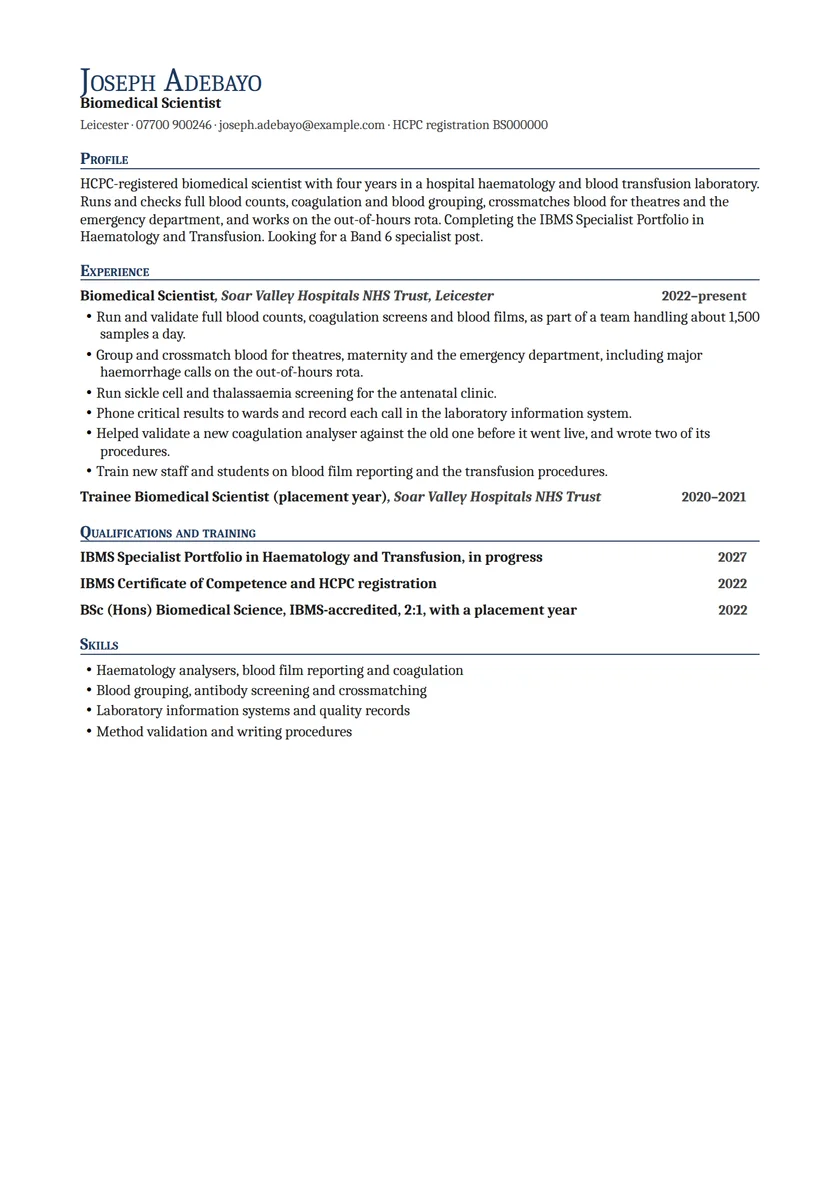
Biomedical scientist CV example

A biomedical scientist's CV is read for registration, discipline and the work you are trusted with.

Put your HCPC registration in the contact lines, name your discipline and IBMS portfolio, give the tests and volumes you handle, and show on-call and quality work. This example is a biomedical scientist four years into haematology and blood transfusion.

Professional design1 page
Read the example as text
Joseph Adebayo
Biomedical Scientist
Leicester · 07700 900246 · [email protected] · HCPC registration BS000000

Profile

HCPC-registered biomedical scientist with four years in a hospital haematology and blood transfusion laboratory. Runs and checks full blood counts, coagulation and blood grouping, crossmatches blood for theatres and the emergency department, and works on the out-of-hours rota. Completing the IBMS Specialist Portfolio in Haematology and Transfusion. Looking for a Band 6 specialist post.

Experience

Biomedical Scientist, Soar Valley Hospitals NHS Trust, Leicester 2022–present

Run and validate full blood counts, coagulation screens and blood films, as part of a team handling about 1,500 samples a day.

Group and crossmatch blood for theatres, maternity and the emergency department, including major haemorrhage calls on the out-of-hours rota.

Run sickle cell and thalassaemia screening for the antenatal clinic.

Phone critical results to wards and record each call in the laboratory information system.

Helped validate a new coagulation analyser against the old one before it went live, and wrote two of its procedures.

Train new staff and students on blood film reporting and the transfusion procedures.

Trainee Biomedical Scientist (placement year), Soar Valley Hospitals NHS Trust 2020–2021

Qualifications and training

IBMS Specialist Portfolio in Haematology and Transfusion, in progress 2027

IBMS Certificate of Competence and HCPC registration 2022

BSc (Hons) Biomedical Science, IBMS-accredited, 2:1, with a placement year 2022

Skills

Haematology analysers, blood film reporting and coagulation

Blood grouping, antibody screening and crossmatching

Laboratory information systems and quality records

Method validation and writing procedures

Fictional example for a biomedical scientist. Every person and employer in it is invented. Replace every detail with your own.

What NHS and private laboratories look for, and where this CV shows it

The job asks you toWhere this CV shows it
Carry out blood grouping and matching for transfusion and transplant servicesGrouping and crossmatching for theatres, maternity and the emergency department
Investigate cells and genomes to uncover hereditary conditionsSickle cell and thalassaemia screening for the antenatal clinic
Research ways to develop new tests and refine existing onesA new coagulation analyser validated before it went live
Update records with data and test resultsCritical results phoned and recorded in the laboratory information system

The left column follows the National Careers Service job profile for a biomedical scientist.

Average pay: £30,000 a year for a starter and £53,000 for an experienced biomedical scientist, working 38 to 40 hours a week (National Careers Service, checked 14 October 2026).

Facts checked against National Careers Service: Biomedical scientist on .

Skills to list for this job

The skills the National Careers Service lists for a biomedical scientist, in CV wording. Put down only the ones you can show, each with where you used it.

  • Biology
  • Analytical thinking
  • Concentration
  • Thorough, with close attention to detail
  • Working well with others
  • Clear spoken communication
  • Maths
  • Chemistry, including the safe use and disposal of chemicals
  • Confident with computers and everyday software
Choose them in the editor

From the National Careers Service profile, checked 17 October 2026.

A profile if you are starting out

This CV's profile is written for someone with experience. Here is the same job at the other level: copy it, or open it in the editor with this CV and write over it.

Biomedical science graduate from an IBMS-accredited degree with a placement year in a hospital haematology laboratory, where the IBMS registration training portfolio was completed. Expecting HCPC registration this autumn. Careful with procedures, quality records and urgent samples. Looking for a first Band 5 biomedical scientist post.
Use in the editor
Inside this example
  • Profile: 54 words here
  • Experience: 118 words here
  • Qualifications and training: 29 words here
  • Skills: 24 words here

How to write yours

01

Registration first

Your HCPC number belongs in the contact lines, where a laboratory manager checks it before reading on.

02

Name your discipline

Haematology, transfusion, microbiology, biochemistry or cellular pathology: say which you work in and which portfolio you hold or are completing.

03

Give volumes and responsibility

Samples a day, on-call work and the urgent calls you handle show the level you work at.

04

Show quality work

Validations, procedures you wrote and audits you joined are what separates a specialist post from a starting one.

Rules and checks for a biomedical scientist's CV

Do I need to be registered with the HCPC?

You must register with the Health and Care Professions Council to work as a biomedical scientist (National Careers Service). Give the registration number in your contact lines and the year under qualifications.

What degree and laboratory experience do I need?

Your degree should be accredited by the Institute of Biomedical Science and approved by the HCPC, and to register you need work experience in an accredited laboratory (National Careers Service). Say where you did yours.

Are there other routes into biomedical science?

The National Careers Service names the Biomedical Scientist Level 6 Degree Apprenticeship, NHS trainee posts and the NHS Practitioner Training Programme. Give your route and its years.

How do I show the NHS values?

You would be expected to understand how the NHS values apply in your work (National Careers Service). Show one with an example in your supporting information.

Professional and one page: the registration sits in the contact lines and the portfolio under qualifications, where a laboratory manager looks first. NHS posts are applied for through NHS Jobs; copy these lines into the supporting information.