Research scientist CV example

A research lab reads a scientist’s CV for what you can design and run, what came of it and whether you can write it up.

Give your degree and PhD, the techniques you use, one result that others now rely on, your papers and any funding you helped win. This example is an industry research scientist applying for a senior post.

Classic design1 page
Read the example as text
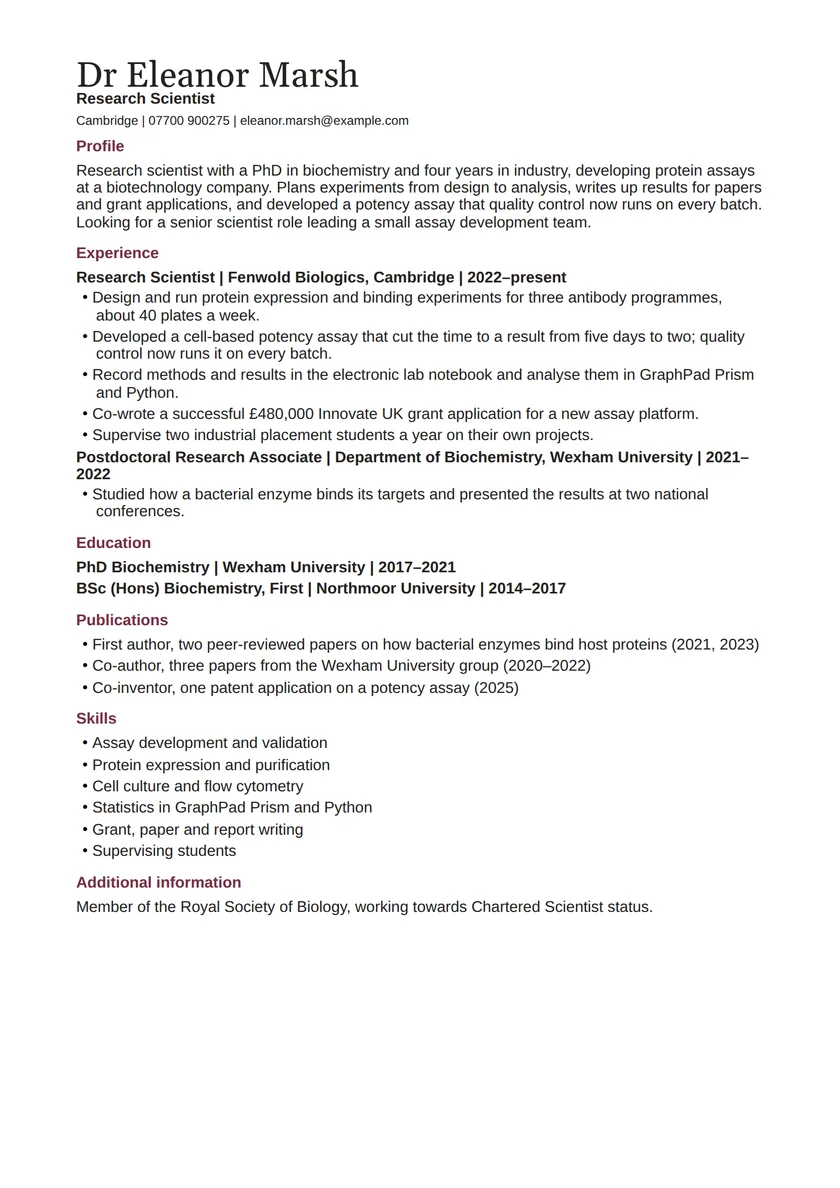
Dr Eleanor Marsh
Research Scientist
Cambridge · 07700 900275 · [email protected]

Profile

Research scientist with a PhD in biochemistry and four years in industry, developing protein assays at a biotechnology company. Plans experiments from design to analysis, writes up results for papers and grant applications, and developed a potency assay that quality control now runs on every batch. Looking for a senior scientist role leading a small assay development team.

Experience

Research Scientist | Fenwold Biologics, Cambridge | 2022–present

Design and run protein expression and binding experiments for three antibody programmes, about 40 plates a week.

Developed a cell-based potency assay that cut the time to a result from five days to two; quality control now runs it on every batch.

Record methods and results in the electronic lab notebook and analyse them in GraphPad Prism and Python.

Co-wrote a successful £480,000 Innovate UK grant application for a new assay platform.

Supervise two industrial placement students a year on their own projects.

Postdoctoral Research Associate | Department of Biochemistry, Wexham University | 2021–2022

Studied how a bacterial enzyme binds its targets and presented the results at two national conferences.

Education

PhD Biochemistry | Wexham University | 2017–2021

BSc (Hons) Biochemistry, First | Northmoor University | 2014–2017

Publications

First author, two peer-reviewed papers on how bacterial enzymes bind host proteins (2021, 2023)

Co-author, three papers from the Wexham University group (2020–2022)

Co-inventor, one patent application on a potency assay (2025)

Skills

Assay development and validation

Protein expression and purification

Cell culture and flow cytometry

Statistics in GraphPad Prism and Python

Grant, paper and report writing

Supervising students

Additional information

Member of the Royal Society of Biology, working towards Chartered Scientist status.

Fictional example for a research scientist. Every person and employer in it is invented. Replace every detail with your own.

What research labs and science companies look for, and where this CV shows it

The job asks you toWhere this CV shows it
Write research proposals and apply for fundingCo-wrote a successful £480,000 Innovate UK grant application
Plan, design and do experimentsExpression and binding experiments for three antibody programmes
Record and analyse resultsElectronic lab notebook; GraphPad Prism and Python
Present findings in journals and at conferencesTwo first-author papers; two national conferences
Develop new products and ways to apply new discoveriesA potency assay now run on every batch; a patent application
Teach and supervise students’ research projectsTwo placement students a year

The left column follows the National Careers Service job profile for a research scientist. If the advert you are answering describes a duty in other words, use its words for work you have actually done.

Average pay: £27,000 a year for a starter and £48,000 for an experienced research scientist, working 39 to 41 hours a week (National Careers Service, checked 17 October 2026).

Facts checked against National Careers Service: Research scientist on .

Skills to list for this job

The skills the National Careers Service lists for a research scientist, in CV wording. Put down only the ones you can show, each with where you used it.

  • Science
  • Maths
  • Solving complex problems
  • Thinking and reasoning
  • Thorough, with close attention to detail
  • Using initiative
  • Clear written communication
  • Working well with others
  • Confident with computers and everyday software
Choose them in the editor

From the National Careers Service profile, checked 17 October 2026.

A profile if you are starting out

This CV's profile is written for someone with experience. Here is the same job at the other level: copy it, or open it in the editor with this CV and write over it.

Biochemistry graduate with a first-class degree, looking for a research assistant post. A year’s industrial placement in a protein science lab, running ELISAs and cell culture, and a final-year project on enzyme kinetics. Keeps a careful lab notebook and is confident with Excel and GraphPad Prism.
Use in the editor
Inside this example
  • Profile: 58 words here
  • Experience: 114 words here
  • Education: 12 words here
  • Publications: 32 words here
  • Skills: 26 words here
  • Additional information: 12 words here

How to write yours

01

Lead with what you can do

Name the techniques and systems you use, so a lab sees at once whether you fit its work.

02

Give one result others use

An assay, method or finding that a team now relies on says more than a list of projects.

03

Keep publications short

On a one-page CV, summarise papers by role and year and offer the full list; an academic CV lists each in full.

04

Show funding and supervision

A grant you helped win and the students you supervise show you are ready to lead.

Questions about a research scientist CV

What degree do I need to be a research scientist?

You usually need a first or 2:1 degree in a science subject, and most research scientists go on to a postgraduate qualification like a PhD (National Careers Service). Give your degree class, and your PhD subject with the years.

How do I show a master’s research project?

An integrated postgraduate master’s course includes independent research and is designed to lead on to a PhD (National Careers Service). Name your project and what it found in one line under Education.

Can I become a research scientist through an apprenticeship?

Degree apprenticeships include Scientist, Biomedical Scientist, Nuclear Scientist and Materials Science Technologist at Level 6 and Clinical Scientist at Level 7, and the Research Scientist Level 7 apprenticeship is equivalent to postgraduate study; they take between 3 and 5 years (National Careers Service). List yours with your employer and the year you expect to finish.

Can I start as a research assistant?

You may be able to start as a research assistant or graduate industrial scientist, usually studying part time for a PhD while you work, and UK Research and Innovation and industrial companies sometimes offer studentships (National Careers Service). Show the job and the PhD side by side with their years.

Do research placements count on a CV?

Work experience in a research department, or a degree with a placement in a research environment, may improve your chances, and graduates could look at Knowledge Transfer Partnerships, which run a project with an organisation and a university (National Careers Service). Give a placement its own entry under Experience.

Classic and one page: a hiring scientist finds your PhD, techniques and results in a plain order. For an academic post with a full publication list, use the Academic design.