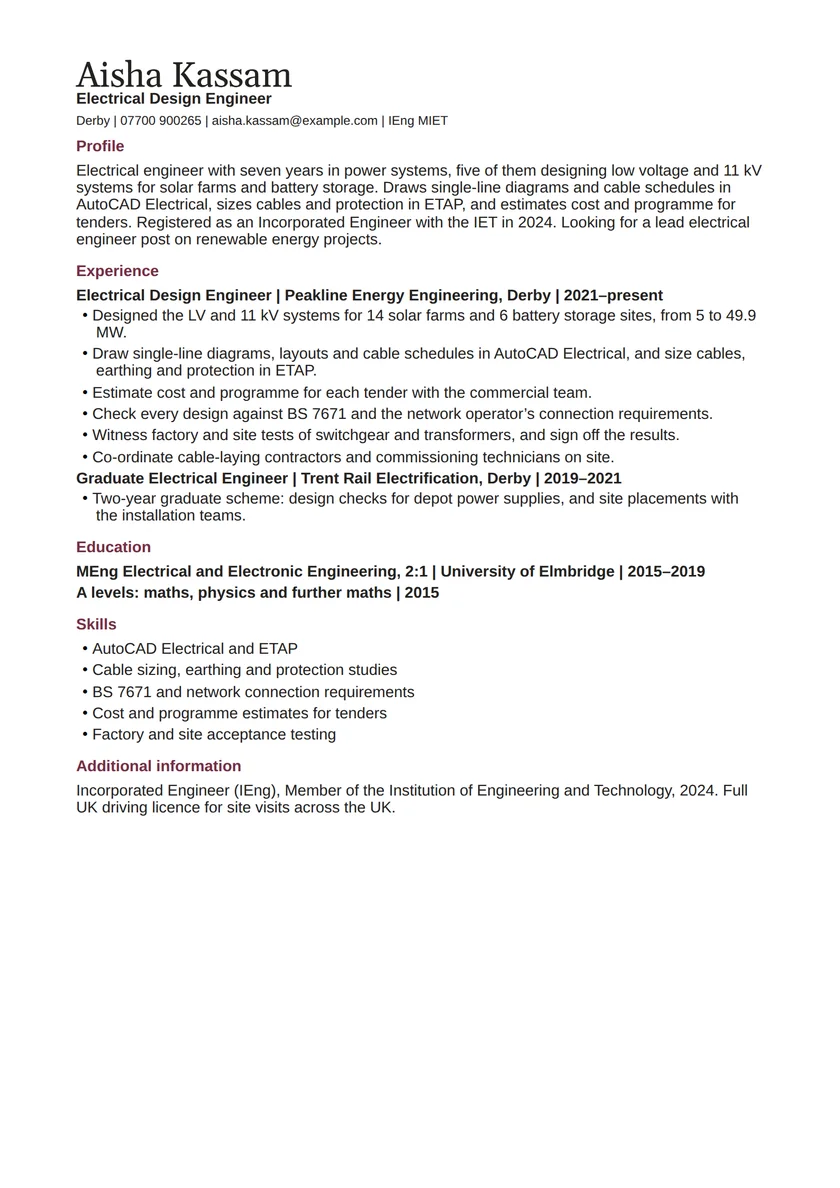
Electrical engineer CV example

An electrical engineer’s CV is read for the systems you design or maintain, their size, and the software and standards you work to. Give voltages, megawatts or sites, the tools you draw and calculate in, and your registration.

This example is a design engineer on solar and battery storage projects applying for a lead role.

Classic design1 page
Read the example as text
Aisha Kassam
Electrical Design Engineer
Derby · 07700 900265 · [email protected] · IEng MIET

Profile

Electrical engineer with seven years in power systems, five of them designing low voltage and 11 kV systems for solar farms and battery storage. Draws single-line diagrams and cable schedules in AutoCAD Electrical, sizes cables and protection in ETAP, and estimates cost and programme for tenders. Registered as an Incorporated Engineer with the IET in 2024. Looking for a lead electrical engineer post on renewable energy projects.

Experience

Electrical Design Engineer | Peakline Energy Engineering, Derby | 2021–present

Designed the LV and 11 kV systems for 14 solar farms and 6 battery storage sites, from 5 to 49.9 MW.

Draw single-line diagrams, layouts and cable schedules in AutoCAD Electrical, and size cables, earthing and protection in ETAP.

Estimate cost and programme for each tender with the commercial team.

Check every design against BS 7671 and the network operator’s connection requirements.

Witness factory and site tests of switchgear and transformers, and sign off the results.

Co-ordinate cable-laying contractors and commissioning technicians on site.

Graduate Electrical Engineer | Trent Rail Electrification, Derby | 2019–2021

Two-year graduate scheme: design checks for depot power supplies, and site placements with the installation teams.

Education

MEng Electrical and Electronic Engineering, 2:1 | University of Elmbridge | 2015–2019

A levels: maths, physics and further maths | 2015

Skills

AutoCAD Electrical and ETAP

Cable sizing, earthing and protection studies

BS 7671 and network connection requirements

Cost and programme estimates for tenders

Factory and site acceptance testing

Additional information

Incorporated Engineer (IEng), Member of the Institution of Engineering and Technology, 2024. Full UK driving licence for site visits across the UK.

Fictional example for an electrical engineer. Every person and employer in it is invented. Replace every detail with your own.

What engineering consultancies and contractors look for, and where this CV shows it

The job asks you toWhere this CV shows it
Draw up project plans and technical diagrams, using engineering design softwareSingle-line diagrams, layouts and cable schedules in AutoCAD Electrical
Estimate costs and project timingsCost and programme for each tender
Test installations and systems, and analyse resultsFactory and site tests of switchgear and transformers, signed off
Make sure projects meet safety regulationsEvery design checked against BS 7671 and the network operator’s requirements
Co-ordinate the work of technicians and craftspeopleCable-laying contractors and commissioning technicians on site
Work on renewable energy systems like solar panels or wind turbines14 solar farms and 6 battery storage sites

The left column follows the National Careers Service job profile for an electrical engineer.

Average pay: £27,000 a year for a starter and £58,000 for an experienced electrical engineer, working 35 to 40 hours a week (National Careers Service, checked 17 October 2026).

Facts checked against National Careers Service: Electrical engineer on .

Skills to list for this job

The skills the National Careers Service lists for an electrical engineer, in CV wording. Put down only the ones you can show, each with where you used it.

  • Engineering science and technology
  • Maths
  • Solving complex problems
  • Design
  • Thorough, with close attention to detail
  • Working well with others
  • Clear spoken communication
  • Persistence and determination
  • Confident with computers and everyday software
Choose them in the editor

From the National Careers Service profile, checked 17 October 2026.

A profile if you are starting out

This CV's profile is written for someone with experience. Here is the same job at the other level: copy it, or open it in the editor with this CV and write over it.

Electrical and electronic engineering graduate (BEng, 2:1) with a 12-month placement at a building services consultancy: lighting and small power layouts in AutoCAD, cable calculations and site surveys with the senior engineer. Final-year project on battery storage for a school’s solar panels. Looking for a place on a graduate electrical engineering scheme.
Use in the editor
Inside this example
  • Profile: 67 words here
  • Experience: 116 words here
  • Education: 18 words here
  • Skills: 27 words here
  • Additional information: 22 words here

How to write yours

01

Give the size

Voltages, megawatts and the number of sites show the scale of what you design.

02

Name your software and standards

Say which design and calculation tools you use, and which standards you check against.

03

Show testing and site work

Witnessed tests and commissioning show that your designs work outside the office.

04

Put registration where it is seen

IEng or CEng with your institution belongs in your contact lines, with the year under Additional information.

Questions about an electrical engineer CV

Which degrees lead to electrical engineering?

You can do a foundation degree or degree in electrical or electronic engineering, or come in with a degree in a subject like electromechanical engineering, building services engineering, applied physics, aeronautical engineering or mechatronics (National Careers Service). Give the degree, its class and the years.

Should I list placements on my CV?

Courses with work experience, such as internships, sandwich placements and vacation schemes, can give you an advantage when applying for jobs or graduate schemes (National Careers Service). On a graduate CV, give each placement its own line.

Which engineering apprenticeships should I name?

You could do an Electrical or Electronic Technical Support Engineer Level 6 Degree Apprenticeship, or an Electro-Mechanical Engineer Level 6 Apprenticeship; these take up to 5 years (National Careers Service). List the apprenticeship with its years.

Can I become an electrical engineer from a technician job?

You could start as an electrical engineering technician and train on the job, or apply with qualifications and several years’ experience in a related area, for example electronics or power generation (National Careers Service). Put that experience first if it is your way in.

Where do I put IEng or CEng?

You can improve your career prospects through professional registration, which can lead to senior roles in project management, electrical design, research and development, contracts management or consultancy (National Careers Service). Put IEng or CEng in your contact lines.

Classic and one page: projects, software and registration read in a steady order for a technical reader. For an online form, switch to Plain.