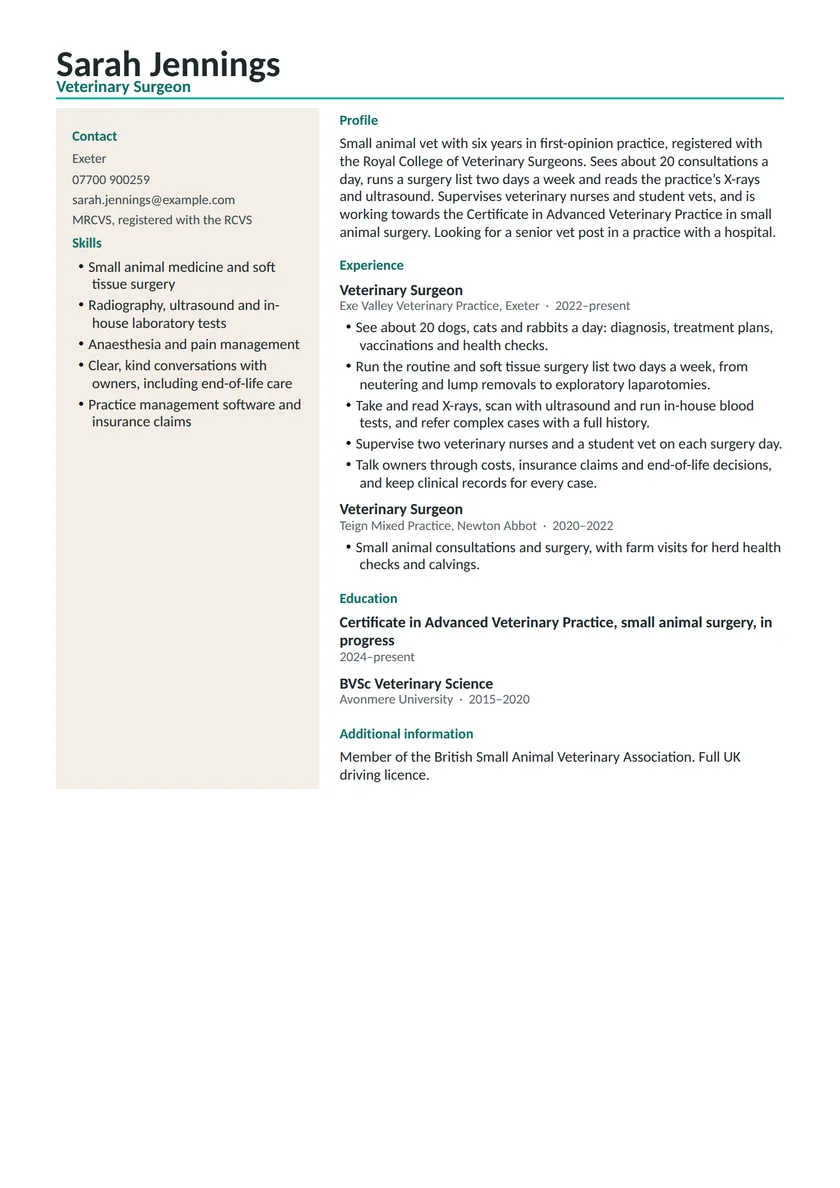
Vet CV example

A practice reads a vet’s CV for your registration first, then for what you see and what you can do on your own.

Put MRCVS in your contact lines, give your caseload and the surgery and diagnostics you do, and show the postgraduate study you are working towards. This example is a small animal vet applying for a senior post.

Modern design1 page
Read the example as text
Sarah Jennings
Veterinary Surgeon

Profile

Small animal vet with six years in first-opinion practice, registered with the Royal College of Veterinary Surgeons. Sees about 20 consultations a day, runs a surgery list two days a week and reads the practice’s X-rays and ultrasound. Supervises veterinary nurses and student vets, and is working towards the Certificate in Advanced Veterinary Practice in small animal surgery. Looking for a senior vet post in a practice with a hospital.

Experience

Veterinary Surgeon Exe Valley Veterinary Practice, Exeter · 2022–present

See about 20 dogs, cats and rabbits a day: diagnosis, treatment plans, vaccinations and health checks.

Run the routine and soft tissue surgery list two days a week, from neutering and lump removals to exploratory laparotomies.

Take and read X-rays, scan with ultrasound and run in-house blood tests, and refer complex cases with a full history.

Supervise two veterinary nurses and a student vet on each surgery day.

Talk owners through costs, insurance claims and end-of-life decisions, and keep clinical records for every case.

Veterinary Surgeon Teign Mixed Practice, Newton Abbot · 2020–2022

Small animal consultations and surgery, with farm visits for herd health checks and calvings.

Education

Certificate in Advanced Veterinary Practice, small animal surgery, in progress 2024–present

BVSc Veterinary Science Avonmere University · 2015–2020

Additional information

Member of the British Small Animal Veterinary Association. Full UK driving licence.

Fictional example for a vet. Every person and employer in it is invented. Replace every detail with your own.

What veterinary practices look for, and where this CV shows it

The job asks you toWhere this CV shows it
Diagnose and treat sick and injured animalsAbout 20 consultations a day, each with a treatment plan
Perform operationsA surgery list two days a week, from neutering to laparotomies
Carry out blood analyses, X-rays and scansX-rays, ultrasound and in-house blood tests
Communicate with pet owners and insurersCosts, insurance claims and end-of-life decisions talked through with owners
Supervise veterinary nurses and support staffTwo veterinary nurses and a student vet on each surgery day

The left column follows the National Careers Service job profile for a vet.

Average pay: £32,000 a year for a starter and £65,000 for an experienced vet, working 40 to 45 hours a week (National Careers Service, checked 17 October 2026).

Facts checked against National Careers Service: Vet on .

Skills to list for this job

The skills the National Careers Service lists for a vet, in CV wording. Put down only the ones you can show, each with where you used it.

  • Animal medicine and dentistry
  • Biology
  • Thorough, with close attention to detail
  • Patient and calm in stressful situations
  • Customer service
  • Clear spoken communication
  • Practical, hands-on work
  • Judgement and decision-making
  • Confident with computers and everyday software
Choose them in the editor

From the National Careers Service profile, checked 17 October 2026.

A profile if you are starting out

This CV's profile is written for someone with experience. Here is the same job at the other level: copy it, or open it in the editor with this CV and write over it.

Newly qualified vet, registered with the RCVS, looking for a first job in a small animal practice with support for new graduates. Final-year rotations in first-opinion practice, a referral hospital and a farm practice, with extra-mural studies in a mixed practice and an equine yard. Confident with routine consultations, vaccinations and neutering under supervision.
Use in the editor
Inside this example
  • Profile: 70 words here
  • Experience: 114 words here
  • Education: 17 words here
  • Skills: 31 words here
  • Additional information: 12 words here

How to write yours

01

Registration in the contact lines

Write MRCVS in your contact lines so the practice can check the register before it reads on.

02

Say what you treat

Small animal, farm, equine or mixed, with your caseload a day, tells a practice whether you fit its work.

03

Give your surgery and diagnostics

List the procedures you do on your own and the imaging and lab work you run, not just “surgery”.

04

Show where you are heading

A CertAVP in progress, or CPD in surgery or medicine, shows the cases you want to take on next.

Questions about a vet CV

Where do I put my RCVS registration?

You’ll need to register with the Royal College of Veterinary Surgeons (National Careers Service). Put MRCVS in your contact lines.

How do I list my veterinary degree?

You need a veterinary degree approved by the RCVS. Full-time degrees usually take 5 to 6 years, or 4 years on a graduate entry course after a related degree (National Careers Service). Give the degree, the university and the years.

Should I list a CertAVP I have not finished?

You might study for a postgraduate qualification like the Certificate in Advanced Veterinary Practice, which gives you options to specialise (National Careers Service). List it with “in progress” and the year you started.

Do vets need a driving licence?

You’ll need to pass enhanced background checks, and you may need a driving licence for some jobs, for example in rural areas (National Careers Service). Put your licence under Additional information if the practice visits farms or homes.

Should I list BVA or BSAVA membership?

You could join the British Veterinary Association and the British Small Animal Veterinary Association, or the British Equine Veterinary Association if you work with horses (National Careers Service). List the memberships you hold.

Modern and one page: registration and skills sit in the side column, so the main column leads with your clinical work. For an online form, switch to Plain.