Postdoc CV example

A postdoc CV is read for what you have found and built, who used it and whether you are ready to lead. Put your research employment and outputs first, then supervision, teaching and service.

This example is a freshwater ecologist applying for a research fellow post; her narrative CV, for funders that ask for one, is our narrative CV template.

Academic design1 page
Read the example as text
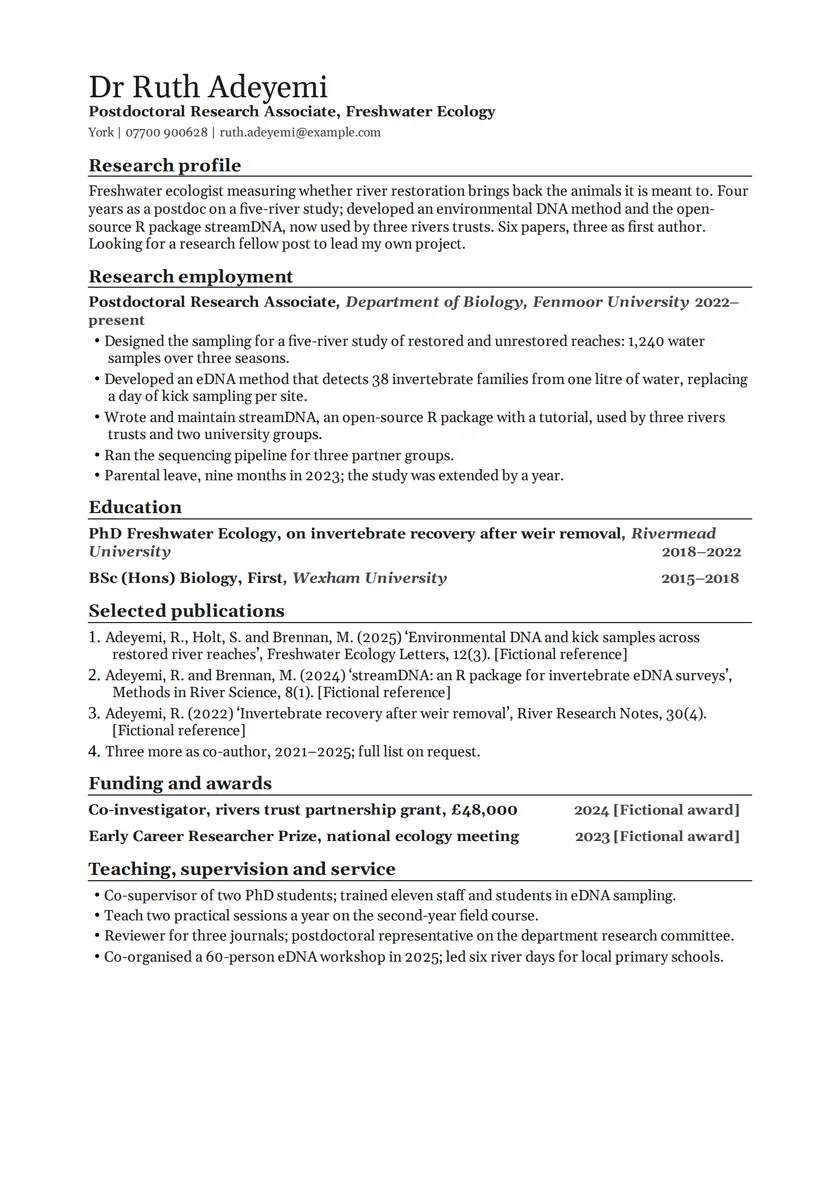
Dr Ruth Adeyemi
Postdoctoral Research Associate, Freshwater Ecology
York · 07700 900628 · [email protected]

Research profile

Freshwater ecologist measuring whether river restoration brings back the animals it is meant to. Four years as a postdoc on a five-river study; developed an environmental DNA method and the open-source R package streamDNA, now used by three rivers trusts. Six papers, three as first author. Looking for a research fellow post to lead my own project.

Research employment

Postdoctoral Research Associate, Department of Biology, Fenmoor University 2022–present

Designed the sampling for a five-river study of restored and unrestored reaches: 1,240 water samples over three seasons.

Developed an eDNA method that detects 38 invertebrate families from one litre of water, replacing a day of kick sampling per site.

Wrote and maintain streamDNA, an open-source R package with a tutorial, used by three rivers trusts and two university groups.

Ran the sequencing pipeline for three partner groups.

Parental leave, nine months in 2023; the study was extended by a year.

Education

PhD Freshwater Ecology, on invertebrate recovery after weir removal, Rivermead University 2018–2022

BSc (Hons) Biology, First, Wexham University 2015–2018

Selected publications

Adeyemi, R., Holt, S. and Brennan, M. (2025) ‘Environmental DNA and kick samples across restored river reaches’, Freshwater Ecology Letters, 12(3). [Fictional reference]

Adeyemi, R. and Brennan, M. (2024) ‘streamDNA: an R package for invertebrate eDNA surveys’, Methods in River Science, 8(1). [Fictional reference]

Adeyemi, R. (2022) ‘Invertebrate recovery after weir removal’, River Research Notes, 30(4). [Fictional reference]

Three more as co-author, 2021–2025; full list on request.

Funding and awards

Co-investigator, rivers trust partnership grant, £48,000 2024 [Fictional award]

Early Career Researcher Prize, national ecology meeting 2023 [Fictional award]

Teaching, supervision and service

Co-supervisor of two PhD students; trained eleven staff and students in eDNA sampling.

Teach two practical sessions a year on the second-year field course.

Reviewer for three journals; postdoctoral representative on the department research committee.

Co-organised a 60-person eDNA workshop in 2025; led six river days for local primary schools.

Fictional example for a postdoctoral researcher. Every person and employer in it is invented. Replace every detail with your own.

What universities and research institutes look for, and where this CV shows it

The job asks you toWhere this CV shows it
Key outputs, such as data sets, software and publicationsstreamDNA, 1,240 water samples and six papers
How you communicated your ideas and resultsThree first-author papers and a workshop for 60 people
Expertise that was critical to the team’s successRunning the sequencing pipeline for three partner groups
Teaching activities, workshops and mentoringTwo PhD students co-supervised; eleven people trained; field course teaching
Reviewing, editing and committee workReviewer for three journals; the department research committee
Engagement with the public sector, clients and the wider publicThree rivers trusts using streamDNA; six school river days

The left column follows the examples UKRI gives for the four modules of its Résumé for Research and Innovation, the narrative CV that many UKRI funding calls ask for. The same researcher’s narrative CV is our narrative CV template.

Facts checked against UKRI: Résumé for Research and Innovation (R4RI) guidance on and UKRI: Core section questions and how they will be assessed on .

A profile if you are starting out

This CV's profile is written for someone with experience. Here is the same job at the other level: copy it, or open it in the editor with this CV and write over it.

Freshwater ecologist in the final year of a PhD on invertebrate recovery after weir removal, across 24 river sites. Designs field surveys, analyses data in R with mixed models, and has one first-author paper under review. Looking for a first postdoctoral post in river or restoration ecology.
Use in the editor
Inside this example
  • Research profile: 57 words here
  • Research employment: 90 words here
  • Education: 19 words here
  • Selected publications: 67 words here
  • Funding and awards: 19 words here
  • Teaching, supervision and service: 50 words here

How to write yours

01

Lead with what you found and built

A method, a data set or software that others now use says more than a list of projects. Give the number of users or samples.

02

Show you are ready to lead

Co-supervision, training others and a grant as co-investigator are the steps a fellowship panel looks for. Put each in its own line.

03

Select your publications

List the three or four that fit the post in full, mark your role, and offer the full list. A panel reads the selection; a full list belongs in an appendix or online profile.

04

Say how a career break shaped the work

One line on parental leave or illness, and what changed in the project, answers the question before it is asked. You decide whether to include it.

Questions about a postdoc CV

Do I need a narrative CV for a fellowship?

Many UKRI funding calls ask for a Résumé for Research and Innovation (R4RI), a narrative CV under four module headings, in the ‘Applicant and team capability to deliver’ section; the call says whether to use it (UKRI, checked 17 October 2026). See our narrative CV guide.

Does each person in a team write one?

UKRI asks for one R4RI for the whole team, even when team members are in different organisations (UKRI). Agree early who writes it, and give each person’s skills.

How long can it be?

Each funding call sets the word count for the R4RI; Additions are optional and can be up to 500 words (UKRI, checked 17 October 2026). A CV for a job has no word count; this one fits on one page, and an academic CV can run to two as your papers grow.

Who reads it?

Your R4RI is seen by reviewers and panel members and is not anonymised (UKRI). Keep it consistent with your CV: the same posts, dates and outputs.

How do I mention a career break?

In an R4RI, career breaks, secondments and voluntary work can go in Additions; focus on how they affected your career rather than on the issue itself (UKRI). On a CV, one dated line is enough.

Academic design on one page, with room for a second as papers are added: a panel finds the research and outputs first, then supervision and service. For a funder that asks for a narrative CV, use the narrative CV template.